

Forklift Robots: Top 7 Autonomous Warehouse Solutions in the USA for 2026
Forklift robots are innovative automated solutions designed to handle the lifting and transportation of heavy loads within warehouses. As businesses in the USA increasingly prioritize efficiency and safety in their operations, these machines have gained significant popularity. They reduce reliance on manual labor, which not only enhances safety by minimizing human error and injury but also boosts productivity. In 2026, forklift robots sit at the intersection of autonomous mobile robots and warehouse automation, offering reliable pallet handling, predictable cycle times, and integrations with warehouse management systems. US buyers favor models that deliver fast return on investment, easy fleet scaling, strong safety certifications, and flexible deployment across distribution centers, manufacturing floors, cold storage, and cross-docking environments. Key consumer preferences include proven uptime, simple operator interfaces, vendor support, and compatibility with existing racking, conveyors, and software ecosystems.
Inception's AI took the time to understand this market in the USA · · How we pickWe may earn a commission on purchases. It never affects our rankings.
Top Picks Summary
MiR500 Autonomous Mobile Robot
The MiR500 Autonomous Mobile Robot is designed for heavy payloads, with the ability to transport up to 500 lbs. It navigates complex environments autonomously, utilizing advanced sensors and a user-friendly interface. What sets it apart is its modular design, allowing easy integration with various equipment and software systems. Plus, its efficient battery life and safety features ensure reliable operation in busy settings.

We may earn a commission on purchases. It never affects our rankings.
Estimated$100,000 – $150,000
OTTO 1500
The OTTO 1500 is a market leader in autonomous material handling designed for heavy-duty applications. It boasts a payload capacity of 1500 lbs and features advanced safety mechanisms to operate seamlessly around people and obstacles. Its ability to integrate with existing infrastructure and systems makes it a versatile choice for various industrial applications. Additionally, OTTO’s commitment to continuous innovation ensures ongoing performance improvements.

Estimated$120,000 – $180,000
Seegrid Palion Pallet Truck
The Seegrid Palion Pallet Truck is renowned for its robust design and ease of use in moving heavy loads within industrial settings. Its autonomous capabilities are complemented by advanced vision technology, enabling it to navigate safely alongside human workers in real time. What distinguishes the Palion is its ability to adapt to both pallet and non-palletized loads, ensuring flexibility in operations. With a focus on efficiency and safety, it provides significant cost savings for companies utilizing automated transport.

Estimated$50,000 – $80,000
Toyota T-Mover Automated Forklift
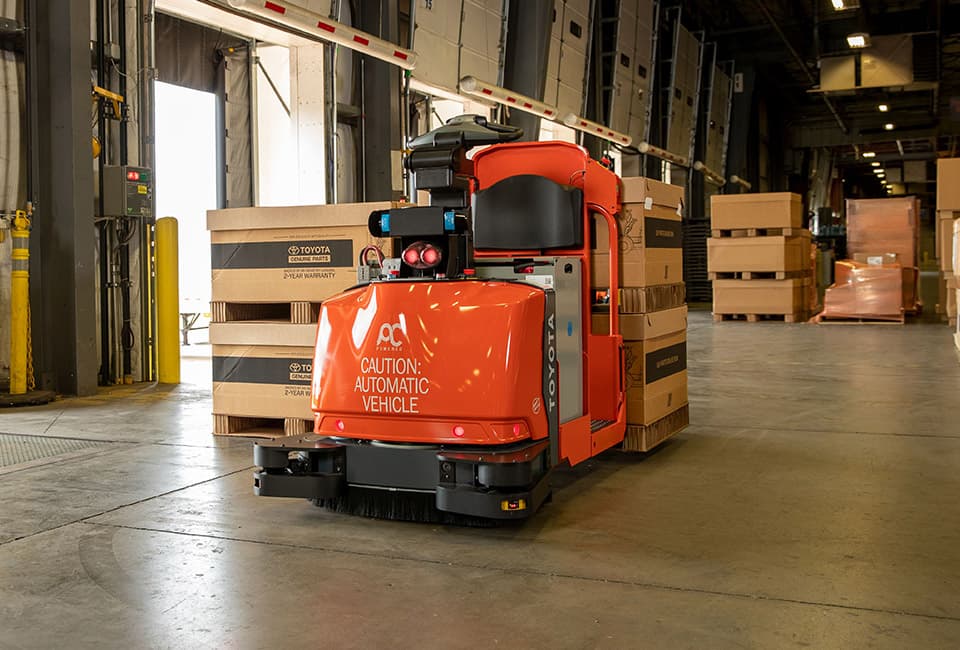
Toyota Material Handling's T-Mover Automated Forklift combines Toyota's proven reliability and safety systems with autonomous navigation optimized for mixed human-robot environments. As a forklift robot it earns a market-leading position for its low total cost of ownership and wide dealer/service network that reduces downtime compared with niche suppliers, while offering smoother integration and predictable lifecycle costs versus heavier-application robots from Linde or Hyster.
We may earn a commission on purchases. It never affects our rankings.
Estimated$80,000 – $180,000
Linde Robotics C-MATIC
Linde Material Handling's C-MATIC is engineered for precision and throughput, with advanced sensor fusion and motion control that excel in narrow-aisle and high-stack forklift robot applications. Its technical edge delivers higher pallet moves per hour for space-constrained operations, though that performance comes with a premium upfront investment compared with more cost-conscious options like Crown's automated pallet trucks.

Estimated$75,000 – $165,000
Crown Auto Pallet Truck
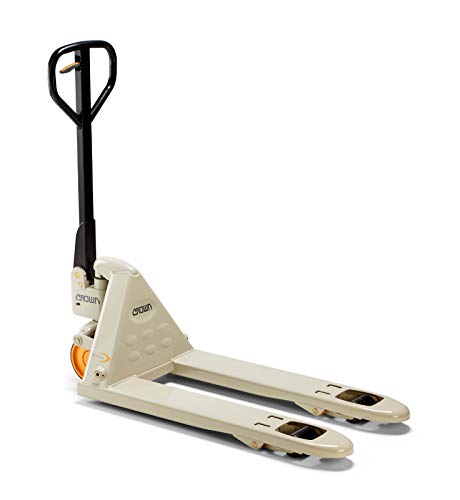
Crown Equipment Corporation's Auto Pallet Truck is a cost-efficient, compact forklift robot designed for rapid deployment in pallet transport and order-fulfillment lanes. It stands out for lower capital expense and fast ROI, making it attractive where high payload stacking isn't required, but it sacrifices the heavy-lift capacity and rugged outdoor capability of models from Hyster or the precision stacking performance of Linde.
Hyster Robotic Lift Truck
Hyster's Robotic Lift Truck focuses on heavy-duty lift capacity and durable construction, making it the go-to forklift robot for outdoor yards and demanding industrial environments where robustness matters most. Financially it competes by reducing manual-labor costs and maintenance frequency under heavy use, though operators seeking the tightest indoor navigation or the smallest footprint may prefer Linde or Crown alternatives.

We may earn a commission on purchases. It never affects our rankings.
Estimated$60,000 – $150,000
Research and evidence behind forklift robots
Multiple industry reports and research studies support the benefits of replacing or augmenting manual forklifts with autonomous forklift robots. Broad findings consistently show improvements in worker safety, throughput, and operational consistency. Research from occupational safety bodies and industry analysts highlights decreased musculoskeletal injuries, fewer accidents caused by human error, and measurable productivity gains when automation is deployed alongside staff retraining and process redesign. Independent industry surveys and technology studies also show that well-implemented robotic fleets reduce handling time per pallet and improve inventory accuracy when integrated with warehouse management software.
Safety: Reports from occupational safety organizations indicate that automation reduces the frequency and severity of material handling injuries by limiting direct human exposure to heavy lifting and repetitive motions.
Productivity: Industry analyses demonstrate that autonomous forklifts provide more consistent cycle times and can operate longer hours than manual equipment, increasing throughput and reducing lead times.
Return on Investment: Case studies collected by supply chain consultancies show typical payback periods for forklift robot projects depend on utilization and labor costs but often occur within 12 to 36 months in high-volume operations.
Scalability and Integration: Research on AMR ecosystems emphasizes the importance of software integration, fleet orchestration, and mapping technologies for achieving predictable performance at scale.
Energy and uptime: Comparative studies highlight that modern electric autonomous forklifts often consume less energy per move and require less maintenance downtime than older internal-combustion models.
Frequently Asked Questions
Which forklift robot should I buy for heavy loads?
For heavy-load warehouse moves, consider the MiR500 Autonomous Mobile Robot, which transports up to 500 lbs, and uses autonomous navigation with flexible payload options; it has an average rating of 4.7.
What payload capacity does the OTTO 1500 forklift robot handle?
The OTTO 1500 forklift robot has a 1500 lbs payload capacity, with advanced obstacle avoidance and customizable operational settings; it’s rated 4.3 on average.
How does the Seegrid Palion compare on price and value?
The provided data doesn’t include prices, but the Seegrid Palion Pallet Truck is positioned as a cost-effective automation solution for efficient pallet handling, with an average rating of 4.7.
Is the Seegrid Palion designed to work near people?
Yes—its autonomous capabilities use advanced vision technology to navigate safely alongside human workers in real time, and it’s rated 4.4 on average.
Conclusion
In the USA market for 2026, forklift robots are a practical, safety-first path to modernizing warehouse operations. This page profiles seven leading options: MiR500 Autonomous Mobile Robot, OTTO 1500, Seegrid Palion Pallet Truck, Toyota T-Mover Automated Forklift, Linde Robotics C-MATIC, Crown Auto Pallet Truck, and Hyster Robotic Lift Truck. Each model suits different facility sizes and use cases, but the MiR500 Autonomous Mobile Robot stands out as the best overall choice for most US warehouses because of its balance of flexibility, safety features, and broad integration support. We hope you found what you were looking for—use the search to refine results by capacity, environment, or vendor, or expand your search to compare additional AMR and automation options.