Educational STEM Toys: Top 5 Picks in the USA for 2026
Published on Monday, January 26, 2026
Educational STEM toys combine science, technology, engineering, and math learning with hands-on play to build critical thinking, creativity, and early technical skills. In the USA market for 2026, parents, educators, and program buyers increasingly favor toys that offer open-ended exploration, progressive skill levels, strong safety and durability, and alignment with classroom or standards-based learning goals. Popular trends include beginner coding kits, modular robotics, maker-style building sets, sustainability-focused materials, and screen-minimizing designs that still teach computational thinking. Consumers choose STEM toys for measurable learning outcomes, long-term play value, clear age guidance, positive reviews, and certifications or safety compliance from trusted bodies.
Top Picks Summary
LEGO Education SPIKE Prime Set
LEGO Education SPIKE Prime is best-in-class for classroom robotics thanks to its durable Technic build elements, a programmable hub that supports both block-based and Python coding, and a curriculum-aligned ecosystem that scales for multiple grade levels. Its higher upfront cost is offset by classroom management tools, longevity and transferability across lessons, giving it more mechanical depth than app-first kits like Osmo and a broader robotics focus than electronics-centered products such as Snap Circuits or littleBits.

Snap Circuits Pro SC-500
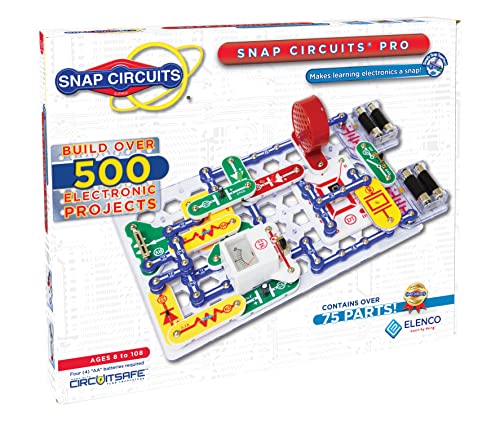
Snap Circuits Pro SC-500 is the market leader for hands-on electronics learning, offering hundreds of snap-together modules that teach authentic circuit concepts with strong safety design and a low cost-per-project. Its technical advantage is genuine electrical components and an expansive project count, making it a more cost-effective, electronics-focused choice compared with themed or robotics-first kits like littleBits or LEGO SPIKE.
Osmo Genius Starter Kit
Osmo Genius Starter Kit stands out for blending physical manipulatives with tablet-based augmented reality to teach early STEM, literacy and math through adaptive digital play. Financially it can be very accessible for homes that already own a tablet, and technically it provides instant feedback and guided progression unlike purely hardware kits such as LEGO SPIKE or Snap Circuits, though it depends on a companion device.

littleBits Star Wars Droid Inventor Kit
littleBits Star Wars Droid Inventor Kit uses magnetic electronic modules and an app-driven interface to make prototyping and basic programming fast, creative and highly engaging through franchise appeal. While licensed branding can raise the price versus no-frills kits, its unique combination of storytelling and rapid-build electronics lowers the engagement barrier compared with more technical options like Snap Circuits and provides quicker creative payoff than purely curriculum-focused systems.

Thames & Kosmos Kids First Coding & Robotics
Thames & Kosmos Kids First Coding & Robotics provides a budget-friendly, screen-free introduction to sequencing and logic with sturdy components and stepwise experiments designed for younger children. Its lower price point and age-appropriate design make it a practical starter that feeds into more technical or classroom-grade systems such as LEGO SPIKE and Snap Circuits as learners grow.

What the Research Shows About STEM Play
A growing body of research and reviews from education organizations and peer-reviewed journals shows that guided, hands-on STEM play supports cognitive, social, and emotional development and helps prepare children for later STEM learning. Evidence favors play that is age-appropriate, scaffolds progressively harder challenges, and includes adult or peer interaction to extend learning.
Early STEM exposure improves problem-solving and spatial reasoning, skills linked to later math and science achievement.
Hands-on, constructive play supports fine motor development, persistence, and the ability to test hypotheses through trial and error.
Coding and robotics toys are shown to build foundational computational thinking skills, including decomposition, pattern recognition, and sequencing.
Collaborative STEM play promotes communication, teamwork, and project-based learning skills valued in classrooms and workplaces.
Inclusive and diverse toy design can reduce early gender and cultural stereotypes and increase interest in STEM among underrepresented groups.
Balanced use of digital-connected toys with offline activities supports learning while minimizing excessive screen time.
Frequently Asked Questions
Which STEM toy should I buy for classroom robotics?
LEGO Education SPIKE Prime Set is best for classroom robotics because it uses a programmable Hub that supports both block-based coding and Python, and it’s designed for classroom use with ready-made lesson plans; it has a 4.6 average rating.
Does Snap Circuits Pro SC-500 include real electronic parts?
Yes—Snap Circuits Pro SC-500 includes real electronic parts, including ICs, transistors, and switches, and it uses snap-together components to build 500+ circuits; it’s rated 4.6 and priced at $94.99 USD
Is Snap Circuits Pro SC-500 a good value at $94.99?
Yes, Snap Circuits Pro SC-500 costs $94.99 USDand lets you build 500+ circuits and electronic experiments without tools; it includes real electronic parts like ICs and transistors and has a 4.6 average rating.
What devices does Osmo Genius Starter Kit work with?
Osmo Genius Starter Kit works with a tablet because its physical game pieces interact with tablet apps for adaptive STEM, spelling, and math; it has a 4.4 average rating and lists for $49.99 USD
Conclusion
This category highlights the landscape of educational STEM toys in the USA for 2026 and what shoppers typically value. Currently there are no top picks listed here, but if you did not find what you were looking for you can refine or expand your search by age range, skill focus, price, safety certifications, sustainability, or product type using the search tools. We hope this overview helps you find the right STEM toys for your needs.