

Ceramic Crowns: Top 7 Options in the USA for 2026
Published on Thursday, February 26, 2026
Ceramic crowns are a popular choice among dental patients in the United States because they deliver a natural-looking appearance together with strong biocompatibility. These dental restorations blend seamlessly with surrounding teeth, resist staining, and minimize the risk of allergic reactions. Driven by growing consumer awareness of dental aesthetics and long-term oral health, demand for ceramic solutions has increased across restorative and cosmetic workflows. In 2026 the market favors materials that balance esthetics and strength: lithium disilicate and zirconia-based systems dominate both private practices and dental laboratories, while zirconia-reinforced glass ceramics and advanced multilayer materials appeal to clinicians who want high translucency plus durability. Trends shaping the category in the USA include wider adoption of CAD/CAM same-day workflows, higher-translucency zirconia for anterior crowns, and a preference for minimally invasive preparations that preserve tooth structure. Cost, insurance coverage, and practice workflow still influence consumer decisions, but many patients prioritize appearance, longevity, and low biological risk when choosing ceramic crowns.
Top Picks Summary
IPS e.max Press by Ivoclar Vivadent
IPS e.max Press is a lithium disilicate pressed ceramic prized for its superior translucency and lifelike esthetics, which makes it a go-to for anterior ceramic crowns where shade matching and natural light transmission are critical. It holds a best-in-class position for balance of strength and optical properties compared with stronger but less translucent zirconia options like BruxZir and Lava, while often offering lower lab layering costs than multi-step veneered restorations. For practices focused on high-esthetic anterior cases, e.max frequently delivers a cost-effective lab workflow with long clinical track record versus newer CAD/CAM-only blocks.

BruxZir Anterior by Glidewell
BruxZir Anterior is a high-translucency monolithic zirconia formulated to deliver superior strength and improved esthetics for anterior crowns, making it a market leader for durable, single-material restorations. It competes technically with glass ceramics like IPS e.max by trading some natural translucency for fracture resistance, and it often provides a financial advantage in high-load or bruxism cases where reduced remake risk lowers long-term costs. Compared with layered zirconia systems, BruxZir Anterior simplifies lab and chairside processing and typically reduces remake and adjustment time.

Kuraray Noritake Katana STML
Kuraray Noritake Katana STML is a multi-layered zirconia engineered with a shade gradient to mimic natural tooth chroma and translucency progression, giving it a technical edge for single crowns that require both strength and lifelike color transition. It sits between homogenous zirconia (BruxZir, Lava) and glass ceramics (e.max, Suprinity) by offering improved esthetics without fully sacrificing the fracture toughness needed for posterior function, often reducing the need for veneering porcelain. For labs and clinics seeking predictable color zoning and fewer cosmetic adjustments, Katana STML can be a cost-efficient compromise between appearance and durability.

VITA SUPRINITY PC by VITA Zahnfabrik
VITA SUPRINITY PC is a zirconia-reinforced lithium silicate (ZLS) glass ceramic that combines high translucency with enhanced mechanical strength, positioning it as a versatile option for both anterior esthetic crowns and reliable posterior restorations. Technically it challenges IPS e.max on optical qualities while offering higher flexural strength that narrows the gap to zirconia-based products, and financially it can reduce the need for complex layering or thick substructures. Compared with chairside-focused ZLS like Celtra, SUPRINITY is often favored by labs for its predictable staining/glazing and lab-press workflows.

Celtra Duo by Dentsply Sirona
Celtra Duo is a zirconia-reinforced lithium silicate block optimized for CAD/CAM workflows and same-day restorations, delivering strong esthetics with a rapid chairside finish that reduces laboratory turnaround and overall restorative cost. It competes directly with VITA SUPRINITY and e.max by offering a fully crystallized option that minimizes post-mill firing for quicker delivery, making it attractive for practices prioritizing efficiency and lower short-term overhead. Compared with full-contour zirconia (Lava, BruxZir), Celtra Duo offers improved translucency while retaining sufficient strength for many single-crown indications, enabling a cost-effective esthetic solution.

3M Lava Esthetic Fluorescent Full Contour Zirconia
3M Lava Esthetic Fluorescent Full Contour Zirconia is a high-translucency zirconia designed to reproduce natural fluorescence and shade behavior, giving it a technical advantage in matching adjacent natural teeth under diverse lighting conditions. It holds a market-leader position for clinicians needing robust, full-contour zirconia that approaches the esthetics of glass ceramics while preserving zirconia-level strength, and it can lower long-term costs by reducing chipping and the need for veneering. Relative to glass-ceramic options like IPS e.max and ZLS blocks, Lava offers greater durability for demanding occlusal situations with competitive lab and milling workflows.

CEREC Tessera by Dentsply Sirona
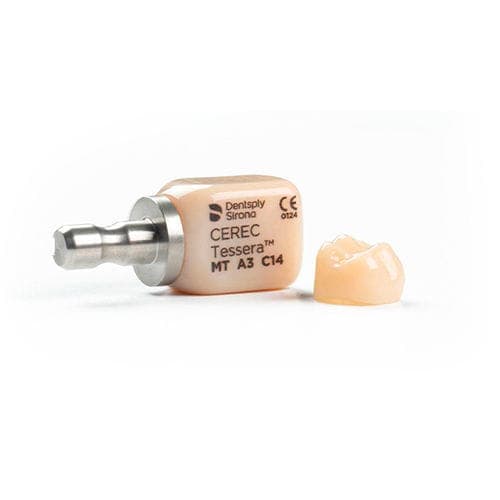
CEREC Tessera is a high-strength glass ceramic developed specifically for chairside CAD/CAM systems, delivering a blend of esthetics, translucency, and fast single-visit turnaround that makes it a leader for same-day ceramic crowns. It competes with IPS e.max and Celtra by emphasizing simplified milling and minimal post-processing while offering esthetic results comparable to laboratory-processed glass ceramics, which can translate to lower patient visit costs and improved practice efficiency. For clinicians invested in in-office CAD/CAM, Tessera reduces lab dependencies and enables predictable, financially efficient restorations without sacrificing high-end optical qualities.
Research and Clinical Evidence on Ceramic Crowns
A substantial body of laboratory testing and clinical research supports the use of modern ceramic crowns. Multiple clinical trials and systematic reviews evaluate lithium disilicate, zirconia, and zirconia-reinforced glass ceramics for survival, esthetic outcomes, and compatibility with adhesive cementation. Research shows that when chosen and bonded correctly, ceramic crowns provide excellent long-term performance for both anterior and posterior restorations. For beginners, the key takeaway is that different ceramic families offer tradeoffs: lithium disilicate prioritizes esthetics and good strength for single crowns and veneers, while high-strength zirconia is favored where fracture resistance is critical. Newer hybrid and reinforced glass ceramics aim to combine the best of both worlds.
Survival and longevity: Clinical studies and meta-analyses commonly report high survival rates for modern ceramic crowns, with many single-tooth restorations showing survival above 90 percent at five years when properly indicated and cemented.
Esthetics: Lithium disilicate (for example, IPS e.max) consistently scores high in esthetic outcomes due to translucency and shade-matching capability; multilayer zirconia and zirconia-reinforced glass ceramics narrow the esthetic gap while improving strength.
Strength and fracture resistance: Monolithic zirconia formulations deliver superior fracture resistance for bruxers and posterior restorations; anterior-focused zirconia variants and materials like BruxZir Anterior improve translucency without sacrificing too much strength.
Biocompatibility and wear: Ceramics are inert and have low allergenicity. Laboratory data indicate that well-polished ceramics cause less wear to opposing enamel than rough or improperly finished restorations.
Bonding and preparation: Adhesive cementation improves fracture resistance for glass ceramics (lithium disilicate and ZLS) while conventional or adhesive cementation strategies are used with zirconia; conservative tooth preparation supports longevity.
Digital workflows: Peer-reviewed studies affirm that CAD/CAM manufacturing and intraoral scanning produce clinically acceptable marginal fit and reduce turnaround time, supporting same-day restorations with materials like CEREC Tessera.
Frequently Asked Questions
Which ceramic crown option should I choose for anterior work?
Choose IPS e.max Press by Ivoclar Vivadent for anterior ceramic crowns because it’s a lithium disilicate pressed ceramic with “excellent esthetics” and natural translucency for predictable shade matching (4.8 average rating).
What exactly makes Kuraray Noritake Katana STML different?
Kuraray Noritake Katana STML uses STML multilayer blocks with natural incisal-to-cervical color graduation, balancing translucency and flexural strength for anterior and posterior crowns (4.7 average rating).
How does price compare for these ceramic crowns?
No prices are provided for IPS e.max Press by Ivoclar Vivadent, BruxZir Anterior by Glidewell, or Kuraray Noritake Katana STML, so I can’t compare value by cost from the data given.
Is BruxZir Anterior good for bruxers or long-span cases?
BruxZir Anterior by Glidewell is engineered for durability in bruxers and long-span ceramic crown cases, using high-translucency monolithic zirconia designed to reduce chipping versus veneered restorations (4.6 average rating).
Conclusion
In the USA market for 2026, ceramic crowns remain a top choice for patients seeking a natural look, reliable biocompatibility, and strong clinical performance. The seven leading options covered here each serve distinct clinical needs: IPS e.max Press by Ivoclar Vivadent, BruxZir Anterior by Glidewell, Kuraray Noritake Katana STML, VITA SUPRINITY PC by VITA Zahnfabrik, Celtra Duo by Dentsply Sirona, 3M Lava Esthetic Fluorescent Full Contour Zirconia, and CEREC Tessera by Dentsply Sirona. For most patients who want a balance of outstanding esthetics and proven longevity, IPS e.max Press by Ivoclar Vivadent stands out as the best overall choice. We hope you found what you were looking for. If you want to refine or expand your search, use the search to filter by material type, translucency, strength, or same-day CAD/CAM compatibility.