

Top 7 Trailer Loading Robots in the USA for 2026
Trailer loading robots sit at the intersection of Autonomous Mobile Robots, Warehouse Robots, and Loading Unloading Robots. In the United States they are rapidly transforming logistics and transportation by automating the repetitive, heavy, and time-sensitive task of loading trailers with cargo. These systems combine payload handling, perception, navigation, and integration with warehouse management systems to reduce labor costs, shorten dwell times at shipping docks, and improve site safety. Buyers in this market prioritize reliability, uptime, ease of integration, and measurable return on investment. They also seek solutions that adapt to mixed-case freight, varying trailer geometries, and peak seasonal volumes. As businesses pursue cost-effective ways to scale distribution and reduce labor risk, trailer loading robots become especially appealing because they deliver consistent throughput, predictable operating costs, and improved worker safety while integrating with existing material handling equipment.
Inception's AI took the time to understand this market in the USA · · How we pickWe may earn a commission on purchases. It never affects our rankings.
Top Picks Summary
Boston Dynamics Stretch
Boston Dynamics Stretch is positioned as the most flexible trailer loading robot on this list thanks to its advanced vision, mobile base and purpose-built gripper that can handle varied boxes and tote geometries inside trailers. Compared with fixed high-throughput palletizers like FANUC and heavy lifters like Vecna, Stretch trades peak throughput for rapid deployment and reduced trailer dwell time, delivering strong operational ROI for mixed-SKU trailer loading applications. Its software adaptability also lowers integration costs versus larger conveyor-based unloaders, making it attractive for sites that need versatility across multiple trailer types.

Estimated$150,000 – $250,000
FANUC M-410iC/185 Palletizing Robot
FANUC’s M-410iC/185 is the market leader when maximum palletizing speed and industrial reliability are primary requirements, offering a high-throughput, long-duty-cycle solution well suited to dedicated trailer loading lines. Compared to mobile or semi-autonomous systems on this list, FANUC delivers lower per-unit task time and predictable maintenance schedules, which can justify higher upfront capital in operations with steady, uniform loads. It is less flexible inside tight or variable trailer geometries than mobile manipulators like Stretch or SlipBot, but financially advantageous where volume and consistency drive ROI.

We may earn a commission on purchases. It never affects our rankings.
Estimated$120,000 – $220,000
Slip Robotics SlipBot
Slip Robotics’ SlipBot shines as a trailer-focused solution engineered to operate inside truck bodies and trailers, offering a compact footprint and tailored navigation for constrained cargo spaces. Against general-purpose palletizers (FANUC) and broad-area AMRs (MiR600), SlipBot’s technical advantage is its trailer-native design that reduces the need for trailer modification and minimizes labor per load, producing a favorable cost profile for fleets with high trailer turnover. Its specialization makes it an efficient middle ground between fast industrial palletizers and more generalized mobile robots.

We may earn a commission on purchases. It never affects our rankings.
Estimated$60,000 – $120,000
Vecna Robotics RC20 Autonomous Forklift
Vecna Robotics’ RC20 autonomous forklift provides enterprise-grade payload capacity and autonomous lift-and-carry capability, making it a market leader for heavy pallet transfers between dock, trailer and yard. Compared with smaller AMRs like MiR600 or manipulators such as Pickle and Stretch, the RC20 reduces manual forklift labor and supports larger, weighty load profiles that mobile manipulators cannot handle, which can deliver substantial labor-cost savings in heavy-volume operations. Its strength is in scaling yard-to-dock workflows where durability and integrated fleet orchestration justify the investment.

Pickle Robot Dill
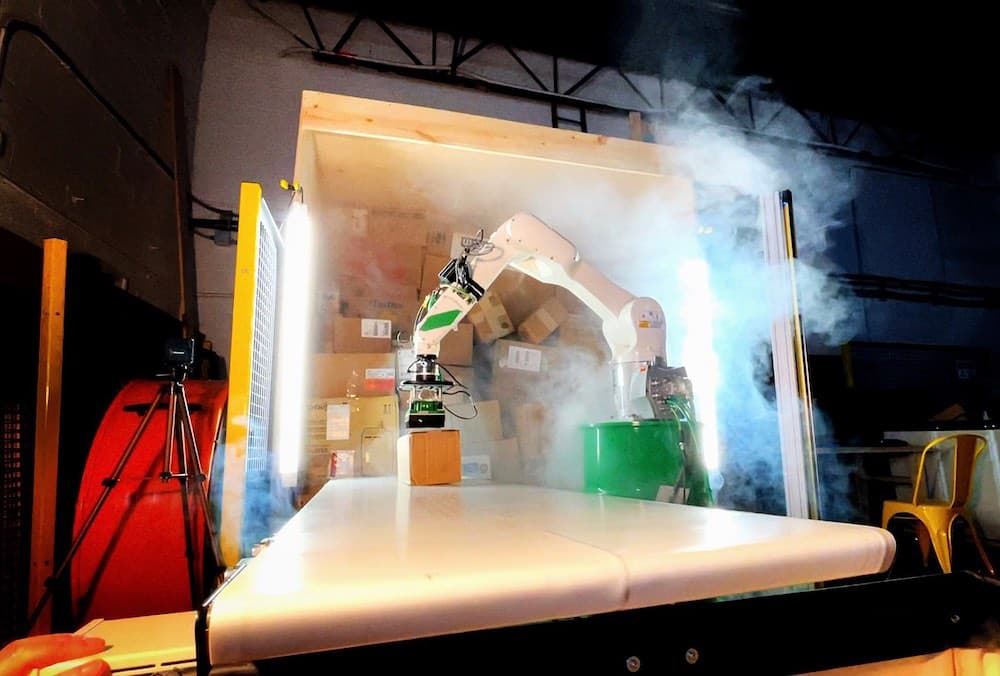
Pickle Robot’s Dill is a compact mobile manipulation platform designed to automate case and carton handling inside trailers with low setup time and a small capital footprint compared to large fixed systems. In contrast to heavy industrial palletizers and forklifts, Dill targets scenarios where mixed-case density and irregular packing require dexterity and quick redeployment, offering a lower-cost entry point to automation for mid-sized distribution centers. Its balance of mobility and manipulation makes it a cost-effective option for facilities prioritizing flexibility over raw throughput.
We may earn a commission on purchases. It never affects our rankings.
Estimated$40,000 – $90,000
Honeywell Intelligrated Robotic Truck Unloader
Honeywell Intelligrated’s Robotic Truck Unloader is a market-leading integrated system that pairs industrial manipulators with conveyors and controls to deliver very high throughput and end-to-end trailer unloading. Compared with standalone robots like Stretch or mobile platforms such as MiR600, Honeywell’s solution is engineered for operations that need turnkey automation, predictable throughput and cohesive material flow, which can lower total cost of ownership where scale justifies the larger capital expense. Its technical advantage is deep integration with warehouse software and conveyor networks, reducing manual touch points in high-volume facilities.

MiR600 Autonomous Mobile Robot
The MiR600 is a versatile autonomous mobile robot that excels at transporting pallets and payloads between dock, staging and trailer areas with minimal infrastructure changes, offering an economical automation layer for trailer loading workflows. Compared to fixed palletizers and autonomous forklifts, MiR600’s strength is rapid deployment, easy fleet scaling and lower upfront system integration costs, making it a compelling choice for facilities that want incremental automation without reworking conveyors or installing heavy-duty equipment. Its mobility pairs well with manipulators or palletizers on this list to create hybrid loading solutions with attractive payback profiles.
We may earn a commission on purchases. It never affects our rankings.
Estimated$60,000 – $100,000
Research and Evidence: Why Trailer Loading Robots Deliver Value
A growing body of industry reports and academic studies supports the benefits of automating trailer loading and unloading. Research and field pilots consistently show improved throughput, lower injury rates, and shorter truck turn times when robots are deployed alongside effective workflow redesign and software integration. The science combines robotics, computer vision, operations research, and human factors to deliver reliable, repeatable results for logistics operators.
Throughput and productivity: Field pilots and industry analyses commonly show notable increases in loading and unloading throughput when robots handle repetitive pallet and case movement, allowing human operators to focus on exception handling and quality control.
Safety and ergonomics: Studies in warehouse ergonomics and occupational health report reductions in musculoskeletal injuries when heavy lifting and repetitive tasks are automated, lowering lost-time incidents and workers compensation costs.
Predictable costs and ROI: Total cost of ownership models used by logistics providers indicate that, for many medium to high volume operations, robotic loading systems can pay back investments within a few years when factoring labor savings, reduced damage, and higher throughput.
Integration and software: Research in systems integration highlights that the biggest gains occur when robots are paired with warehouse execution systems, trailer management tools, and good operational design rather than being deployed in isolation.
Scalability: Case studies show modular robot fleets and flexible end effectors allow quicker scaling for seasonal peaks and changing SKU profiles compared with fixed conveyor-only approaches.
Frequently Asked Questions
Which robot should I pick for mixed box trailer loads?
Boston Dynamics Stretch fits mixed box trailer loading best, with advanced vision plus an end-of-arm gripper to identify and pick varied box sizes and shapes, and it’s rated 4.7 on average.
What exact feature helps SlipBot handle narrow trailer aisles?
Slip Robotics’ SlipBot uses a lightweight, compact footprint designed to operate inside narrow trailer aisles, and it supports autonomous operation plus remote/teleoperation modes for flexible deployment; average rating is 4.3.
Is FANUC M-410iC/185 better value than a mobile robot?
The data only lists FANUC M-410iC/185 as a high-throughput, long-duty-cycle solution for dedicated trailer loading lines, but it does not provide any price; its average rating is 4.6 and it targets a payload class ~185 kg.
Does Stretch work well for high cycle trailer case handling?
Boston Dynamics Stretch is designed for high-throughput case handling inside trailers and on pallet lines, using a compact mobile base for maneuvering inside trailer aisles and high cycle rates; average rating is 4.7.
Conclusion
Trailer loading robots are a practical, high-impact investment for U.S. logistics and transportation operations that need to move more freight faster and safer. The seven top options profiled on this page include Boston Dynamics Stretch, FANUC M-410iC/185 Palletizing Robot, Slip Robotics SlipBot, Vecna Robotics RC20 Autonomous Forklift, Pickle Robot Dill, Honeywell Intelligrated Robotic Truck Unloader, and MiR600 Autonomous Mobile Robot. For many trailer-loading use cases the Boston Dynamics Stretch stands out as the best overall choice because of its trailer-focused design, advanced perception, and proven field deployments, though the right pick depends on payload, trailer type, and integration needs. I hope you found what you were looking for. You can refine or expand your search using the site search to compare specifications, warranty options, and deployment case studies.