

Top 7 Agricultural Harvesting Robots in the USA — 2026 Guide
Agricultural harvesting robots are transforming American farming by automating crop collection with autonomous mobile robot platforms built for logistics and fieldwork. As Service Robots in the Logistics Robots > Autonomous Mobile Robots category, these machines combine machine vision, manipulators, GPS guidance, and fleet coordination to harvest fruits, vegetables, and other high-value crops more consistently and with less human labor. In the USA, growers prefer harvesting robots because they address persistent labor shortages, reduce per-unit picking costs, limit product damage through precise handling, and enable longer operating windows with night or 24/7 operation. Buyers also value integration with farm management systems, data capture for yield optimization, and modular designs that scale from small specialty farms to large commercial fields. Improvements in AI perception, battery life, and cloud-based fleet orchestration have accelerated real-world adoption and made automated harvesting a practical investment for many operations across varied climates and crop types.
Inception's AI took the time to understand this market in the USA · · How we pickWe may earn a commission on purchases. It never affects our rankings.
Top Picks Summary
Harvest CROO Strawberry Harvester
Harvest CROO's Strawberry Harvester stands out as a pioneering solution for large-scale strawberry farms, focusing on efficiency and reducing labor challenges. Its unique multi-functional design allows it to pick strawberries while simultaneously evaluating fruit quality in real time. This not only streamlines the harvesting process but also ensures the finest berries are selected and packed. With its robust engineering and smart technology, Harvest CROO is transforming the berry harvesting paradigm.

We may earn a commission on purchases. It never affects our rankings.
Estimated$150,000 – $200,000
Agrobot SW6010
The Agrobot SW6010 is pushing the boundaries of agricultural technology with its innovative design tailored specifically for strawberry harvesting. This sophisticated robot utilizes high-resolution cameras and AI algorithms to assess fruit ripeness and navigate rows effectively. What sets the SW6010 apart is its ability to work alongside human laborers rather than replacing them, fostering a more collaborative farming environment. Agrobot continues to lead the market with its emphasis on sustainability and efficiency.

Advanced Farm Technologies T-22
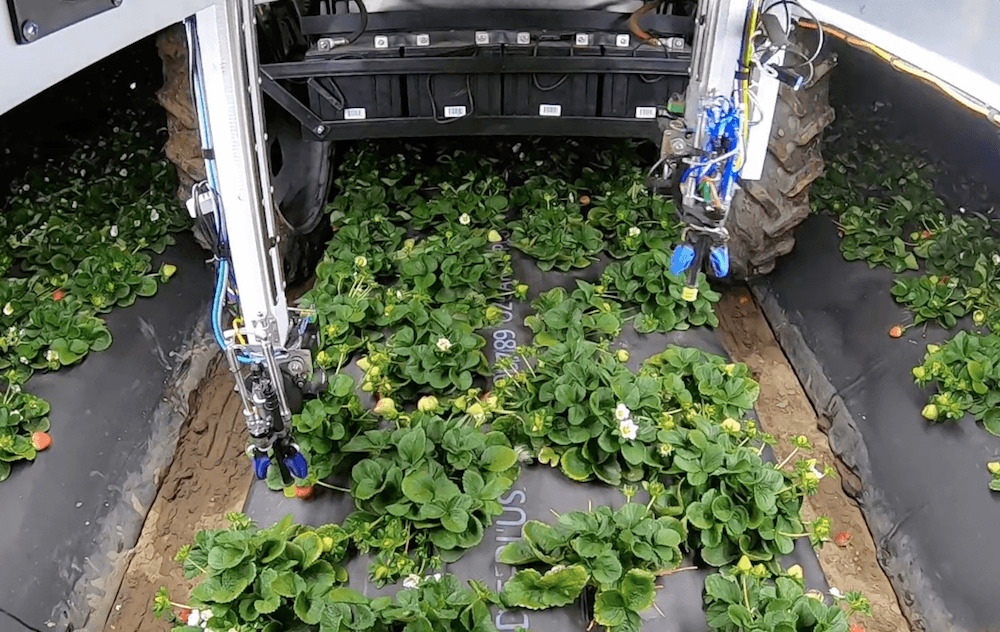
Positioned as a best-in-class heavy-duty harvester for large-acreage operations, the T-22 delivers high throughput and uptime that translate to a low cost-per-acre compared with specialty pickers. Its industrial-grade drivetrain and simplified maintenance reduce operating expenses versus the more delicate Tortuga BerryBot, while offering higher sustained field speed than the FieldWork Fieldbot and greater integrated harvesting capability than the Burro platform. For farms prioritizing volume and ROI on row crops, the T-22’s robustness and predictable service profile make it the economical leader.
We may earn a commission on purchases. It never affects our rankings.
Estimated$60,000 – $120,000
Tortuga AgTech BerryBot
The BerryBot is the market leader for delicate-fruit harvesting thanks to its high-precision vision and soft-end-effector design, which yields industry-leading pick accuracy and fruit quality retention. Financially it offsets labor shortages by delivering superior yield recovery compared with heavier systems like the T-22, and technically it complements platforms such as Burro by focusing on fruit handling where FieldWork’s generalist Fieldbot may trade off finesse for flexibility. Farms with high-value berries see quicker payback from BerryBot’s reduced bruising and higher marketable yield.

We may earn a commission on purchases. It never affects our rankings.
Estimated$30,000 – $80,000
FFRobotics FFRobot
FFRobotics' FFRobot is revolutionizing the agricultural landscape with its state-of-the-art robotic technology designed for picking fruit. Unlike other robots, the FFRobot boasts advanced perception systems that allow it to navigate and adapt to varying orchard environments. Its versatility and efficiency not only enhance productivity but also reduce labor costs significantly. With a commitment to innovation, FFRobotics stands at the forefront of agricultural robotics.

FieldWork Robotics Fieldbot
Fieldbot is best-in-class for modularity and mixed-crop adaptability, offering plug-and-play end-effectors and sensor suites that let operators switch between tasks faster than the specialized BerryBot or the heavier T-22. Its mid-range capital cost and subscription-friendly software updates make it a cost-effective choice for diversified farms that need one robot to handle several harvesting profiles rather than investing in multiple single-purpose machines. Technically, Fieldbot bridges the gap between high-throughput harvesters and delicate pickers while keeping integration and training costs comparatively low.

We may earn a commission on purchases. It never affects our rankings.
Estimated$25,000 – $70,000
Burro Grande Autonomous Platform
The Burro Grande is the market-leading autonomous transport and mobile-platform solution that optimizes harvesting logistics by reducing carry-and-transport labor and enabling continuous picker-to-processor workflows. Its high payload and fleet-management software lower per-ton transport costs and integrate seamlessly with pickers such as the BerryBot and Fieldbot, unlike the self-contained T-22 which focuses on harvesting rather than in-field transport. For operations aiming to maximize throughput and reduce handling bottlenecks, Burro’s platform delivers measurable operational savings and smoother field operations.

We may earn a commission on purchases. It never affects our rankings.
Estimated$90,000 – $180,000
Research and Evidence Behind Harvesting Robots
Multiple studies and extension reports from universities and agricultural research centers in the United States show that automated harvesters can increase throughput, reduce labor reliance, and improve consistency of picked produce when systems are matched to the crop and farm workflow. Research typically evaluates picker accuracy, bruising or quality outcomes, operating hours per day, and economic models comparing capital and operating costs against manual labor. Results vary by crop and maturity of the technology, but consensus points toward meaningful gains where robotics reduce repetitive labor, enable timely harvest windows, and integrate with precision agronomy practices.
Labor and cost studies: University extension analyses and USDA reports indicate that robotics can significantly reduce seasonal labor needs and lower per-unit harvest costs as utilization rises and systems are optimized for specific crops.
Quality and handling: Machine-vision guided pickers from research projects and pilots show reduced bruising and more consistent selection of optimally ripe fruit compared with inexperienced human pickers.
Throughput and uptime: Field trials demonstrate that autonomous systems can extend harvesting hours into evenings and early mornings, raising daily throughput compared with strictly daylight operations.
Environmental and sustainability impacts: Lifecycle assessments and pilot studies show potential for reduced fuel use and lower emissions when electric autonomous platforms replace diesel tractors and transport runs.
Adoption factors: Research stresses that success hinges on crop-specific end effector design, reliable perception in variable lighting, and robust maintenance and service models to keep systems productive.
Frequently Asked Questions
Which harvesting robot should a large strawberry farm buy?
Harvest CROO Strawberry Harvester fits large-scale strawberry farms, since it’s built for high efficiency, fast harvesting speed, and automated quality control, with an average rating of 4.7.
Does Advanced Farm Technologies T-22 support sub-decimeter positioning?
Yes—Advanced Farm Technologies T-22 uses autonomous row-following with RTK-GPS and LiDAR for sub-decimeter positioning, has an average rating of 4.7, and includes interchangeable end-effectors.
How does Advanced Farm Technologies T-22 price compare to others?
The provided data doesn’t list any prices for Harvest CROO Strawberry Harvester, Agrobot SW6010, or Advanced Farm Technologies T-22, so I can’t compare value by cost.
What’s the battery life and uptime expectation for T-22?
Advanced Farm Technologies T-22 lists 8–10 hour battery life with quick-swap modules and cloud fleet management, and it’s rated 4.7; no warranty duration is provided in the data.
Conclusion
Agricultural harvesting robots are rapidly moving from pilot projects to practical tools across American farms. The seven leading options covered here — Harvest CROO Strawberry Harvester, Agrobot SW6010, Advanced Farm Technologies T-22, Tortuga AgTech BerryBot, FFRobotics FFRobot, FieldWork Robotics Fieldbot, and Burro Grande Autonomous Platform — represent a range of scale, crop focus, and autonomy. For many growers seeking a balance of commercial maturity, precision picking, and vendor support, the Agrobot SW6010 stands out as the best overall choice on this list. I hope you found the information you were looking for; use the search to refine by crop type, field size, or budget, or expand your search to compare features and local dealer support.