

Top 7 Professional Audio Interfaces in the USA for 2026
Published on Thursday, February 26, 2026
Professional audio interfaces are essential for musicians, producers, and sound engineers, providing high-quality audio input and output with minimal latency. In the United States, home to a vibrant music scene and a large audio production industry, demand for reliable, low-noise, and flexible interfaces has surged. These devices serve as the bridge between microphones, instruments, and computers, supporting a wide range of audio software and enabling seamless recording, mixing, and monitoring workflows. Consumer preferences in the US market tend toward interfaces that combine exceptional analog-to-digital and digital-to-analog conversion, robust mic preamps, stable drivers, and modern connectivity like Thunderbolt, USB-C, and network audio standards. Portability, expandability, onboard DSP for near-zero-latency monitoring, and clear product ecosystems with plugin support are also high priorities. As more professionals set up home studios and collaborate remotely, choosing the right interface depends on channel count, I/O flexibility, latency performance, and long-term driver and firmware support.
Top Picks Summary
Universal Audio Apollo x4
The Universal Audio Apollo x4 is a premium audio interface that sets a high standard in studio quality. With its built-in UAD processing, users can track with industry-leading plug-ins in real-time, providing unmatched audio fidelity and flexibility. The Apollo x4 also features a stunning 4-in/4-out configuration with world-class AD/DA conversion, offering clarity and detail that surpasses competitors. Its elegant design and comprehensive software bundle make it an ideal choice for professional musicians and sound engineers alike.

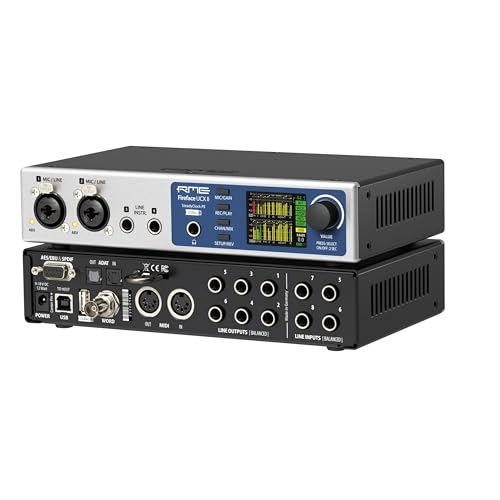
RME Fireface UCX II
RME Fireface UCX II is a highly regarded audio interface known for its exceptional performance and reliability. It features ultra-low latency and high-quality AD/DA conversion, making it the go-to choice for many professional studios. The compact design houses a versatile set of inputs and outputs, catering to both mobile and stationary recording setups. With its sturdy build and advanced features, the Fireface UCX II sets itself apart as a leader in the competitive audio interface market.
Apogee Symphony I/O Mk II
The Apogee Symphony I/O Mk II is renowned for its outstanding audio fidelity and modular design, making it a favorite among professional audio engineers. Its seamless integration with Logic Pro, alongside high-performance converters, ensures unparalleled sound quality and flexibility. The ability to customize through varying I/O configurations allows it to adapt to any studio setup, providing both USB and Dante connectivity. This innovative product stands out as a leader in the audio interface market, embodying Apogee's legacy of excellence.

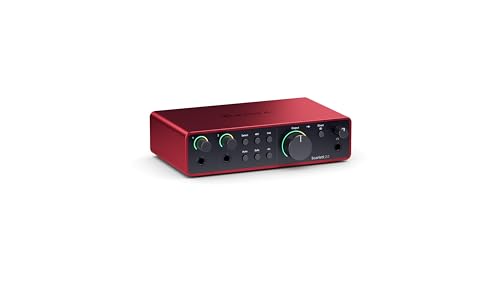
Focusrite Scarlett 2i2 4th Gen
The Scarlett 4i4 4th Gen is a value-focused professional interface that delivers low-latency performance, improved converters and versatile routing at a price that undercuts most rack units — making it the best choice when budget and reliable studio features matter. Compared with the MOTU 828es it offers fewer I/O and no AVB networking but wins on cost and simplicity for desktop workflows, and while its preamps are clean and modern they are positioned a notch below the boutique warmth and console-derived circuitry of the Audient and SSL units.
MOTU 828es
The 828es is a market-leading, pro-grade interface prized for its extensive I/O, ultra-stable drivers, high-quality converters and AVB Ethernet networking, making it ideal for studios that need scalable routing, tight clocking and multi-device setups. Compared to the Scarlett 4i4 and the smaller two-channel Audient and SSL models, the 828es carries a higher price but delivers significant technical advantages — native networked audio, expanded analog and digital connectivity and hardware DSP mixing for complex professional environments.

Audient iD14 MkII
The iD14 MKII stakes its place as a best-in-class compact interface by pairing Audient’s well-regarded console-style mic pres, high-performance converters and ergonomic desktop controls, yielding a sonic character and headroom favored for critical tracking. It typically rivals the Scarlett 4i4 on features but tends to outshine it in preamp quality and dynamic response, while remaining far more affordable and simpler to integrate than the MOTU 828es rack solutions — a top pick for singer‑songwriters and small project studios that prioritize sound over maximum I/O.

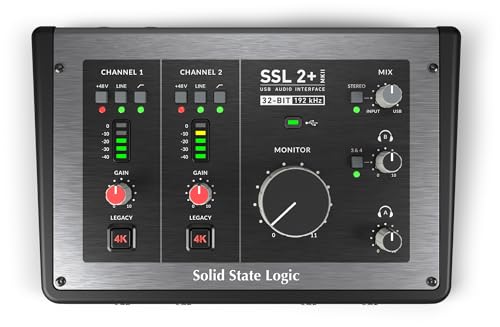
SSL2+ Solid State Logic
The SSL 2+ leverages Solid State Logic’s console heritage to offer premium-sounding preamps, rugged build and the proprietary 'Legacy 4K' analogue enhancement, giving users an immediate professional tonal color not found in most budget interfaces. Financially it sits between the entry-level Scarlett and the higher-end MOTU, delivering studio-grade character and tactile controls that make it a strong choice for professionals who want console-like flavor and ergonomics without committing to a larger, more expensive rack system.
Why high-quality audio interfaces matter: research-backed benefits
Industry research and peer-reviewed work in audio engineering show that interface performance affects both technical results and human perception. Objective measures such as dynamic range, signal-to-noise ratio, total harmonic distortion plus noise (THD+N), and jitter directly influence recording fidelity. Studies and technical reports from audio engineering organizations demonstrate that stable drivers and low round-trip latency improve real-time performance and creativity during tracking. While some measurable improvements can be subtle to untrained listeners, trained engineers and critical listeners consistently report better results with high-end conversion and preamplification, especially in professional mixing and mastering contexts.
Low latency is critical for real-time monitoring and tracking; round-trip latency under roughly 10 milliseconds is generally imperceptible to performers.
High dynamic range and low noise floor preserve detail and headroom, reducing the need for corrective processing later in the signal chain.
Quality ADC and DAC circuits reduce distortion and timing errors, which is important for mixing, mastering, and multitrack recording.
Stable drivers and solid firmware reduce dropouts and improve session reliability, a key factor validated by user studies across professional studios.
Onboard DSP and real-time monitoring reduce CPU load on host systems and allow zero-latency monitoring with effects, backed by industry adoption and performance evaluations.
Frequently Asked Questions
Which interface should I buy for real-time tracking needs?
Universal Audio Apollo x4 is a strong pick for real-time tracking because it has real-time UAD plugin processing and four Unison preamps, with an average rating of 4.8.
What does Universal Audio Apollo x4 include for recording?
Universal Audio Apollo x4 includes four Unison preamps for versatile recording, plus high-quality audio conversion and real-time UAD plugin processing, with a 4.8 average rating.
Is RME Fireface UCX II better value than Apollo x4?
RME Fireface UCX II costs $1,699.00 USDversus Apollo x4 at $1,699.00 USDwhile both have very strong ratings: UCX II is 4.8 and Apollo x4 is 4.8.
Does Apogee Symphony I/O Mk II work for modular studio setups?
Yes—Apogee Symphony I/O Mk II is described as modular, allowing custom configurations, and it’s rated 4.7 with a listing price of $5,995.00 USD
Conclusion
In the US market, the right audio interface balances sound quality, connectivity, and workflow needs. The seven main options covered here — Universal Audio Apollo x4, RME Fireface UCX II, Apogee Symphony I/O Mk II, Focusrite Scarlett 4i4 4th Gen, MOTU 828es, Audient iD14 MKII, and SSL 2+ — represent a range from high-end studio converters and DSP-enabled workstation interfaces to compact, budget-friendly units for project studios. For most professional users who need a combination of pristine conversion, reliable drivers, and integrated realtime processing, the Universal Audio Apollo x4 stands out as the best overall choice on this list. RME Fireface UCX II and Apogee Symphony I/O Mk II are excellent for engineers focused on rock-solid stability and top-tier conversion respectively; Focusrite Scarlett 4i4 4th Gen and Audient iD14 MKII offer strong value for small studios; MOTU 828es is notable for routing and network audio features; and SSL 2+ brings classic console-style feel in an affordable package. I hope you found what you were looking for — you can refine or expand your search by channel count, connectivity (Thunderbolt, USB-C, AVB), DSP needs, or price using the site search.